Pet Passport Requirements for Moving from Dubai to the UK
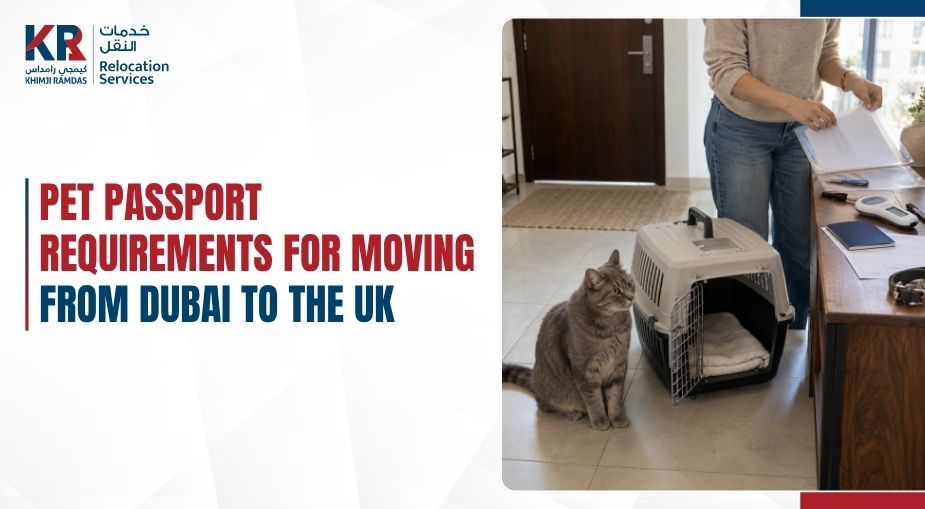
Pet passport requirements for moving from Dubai to the UK can be more involved than many owners expect, especially when a cat or dog must meet veterinary, airline and UK entry conditions on a fixed travel date.
A successful move depends on matching the microchip, vaccinations, health documents, carrier, flight arrangements and arrival plan. This guide explains what to check, when to start, which details can vary, and how Khimji Ramdas Relocation Services can help coordinate the practical parts of international pet travel.
Pet Passport Requirements for Moving from Dubai to the UK
When people say they need a pet passport, they often mean a complete set of documents proving that their pet is correctly identified, vaccinated, examined and eligible to travel.
For a move from Dubai to the UK, that phrase should not be treated as a guarantee that one booklet or document will satisfy every requirement.
The correct paperwork depends on factors such as the species, the pet’s country of origin, the travel date, the route, whether the movement is classified as non-commercial or commercial, and the latest rules applied by UK authorities and the airline.
Requirements can change, so you should confirm them with the UK Government’s official guidance, the relevant UAE authorities, an authorised veterinarian and the airline before booking.
What a Pet Passport Can and Cannot Prove
A pet passport or vaccination record can provide an important history of your pet’s identity and medical treatment. It may show the microchip number, rabies vaccination details, dates, veterinary stamps and other supporting information.
However, it does not automatically replace any health certificate, import document, laboratory result or airline form that may be required for the specific journey.
For many journeys to Great Britain, owners need an official animal health certificate or another accepted document rather than relying only on an EU-style pet passport.
The document must normally be completed within the permitted period and must correspond exactly with the pet’s microchip and travel information. Your veterinarian or competent authority should confirm which document applies to your circumstances.
Why a Dubai-to-UK Move Needs Careful Timing
The most common planning error is starting with the flight date instead of working backwards from the veterinary and documentation steps. A rabies vaccination, any required antibody test, the issue of a health certificate and the airline’s booking process may all have different timing requirements.
When checking pet passport requirements, keep this point in view: A mistake in the microchip number, a vaccination given before the chip is recorded, an expired treatment window or a certificate issued too early can create avoidable problems.
These are not details to correct casually at the airport. Begin by making a dated plan and have the dates checked by a veterinarian familiar with international pet travel.
The First Information to Confirm
Before buying a ticket or carrier, confirm the following with the appropriate official and commercial parties:
- The current UK entry rules for your pet’s species and country of departure.
- Whether a rabies antibody test, waiting period or additional certificate applies.
- Whether the airline accepts pets on your chosen route and under which transport conditions.
- Whether the arrival airport and route are approved for the type of pet movement involved.
Pet passport planning should include this detail. Khimji Ramdas Relocation Services can help you organise the coordination around these steps, but official authorities, authorised veterinarians and airlines remain responsible for their own requirements and decisions.

Tell us about your move and get a personalized quote based on your requirements.
Which Documents and Veterinary Steps Does Your Pet Need?
Pet passport planning should include this detail. A Dubai-to-UK pet move is best managed as a chain of linked checks, and understanding pet moving process helps you see how each step fits into the journey.
Each step must support the next one, with information remaining consistent from the microchip scan through to the travel document and airline booking. Do not assume that a previous vaccination history will be accepted without review, as every detail must meet the applicable UK entry requirements.
Microchip and Identity Matching
Your pet should have a compatible identification microchip, and the number recorded on every document must match the number scanned by the veterinarian and the airline or official authority.
Ask the vet to scan the chip before completing any certificate. Keep a written copy of the number and, if possible, a photograph or record of the scan details.
This is an important pet passport preparation detail. The order of events can matter. For example, a rabies vaccination may need to be administered after the microchip has been implanted and recorded for it to count under the applicable rules.
Your veterinarian should check the chronology rather than simply copying dates from an old vaccination card.
Rabies Vaccination and Waiting Periods
To keep pet passport records accurate, account for this point: Rabies vaccination is a central part of most international dog and cat travel plans.
The vaccine must be authorised for the animal, administered by an appropriate veterinarian and documented correctly. Depending on the applicable UK classification and the pet’s history, a minimum waiting period may apply before travel.
Do not calculate the travel date from memory. Ask the veterinarian to confirm the earliest eligible date based on the actual microchip and vaccination records. If a booster has lapsed, the rules may treat the new vaccination differently from a continuous, valid vaccination history.
Rabies Blood Testing Where Applicable
Within the pet passport process, confirm this detail: For pets travelling from countries or circumstances subject to additional controls, a rabies antibody blood test may be required after vaccination, followed by a prescribed waiting period before entry.
Whether this applies to your pet should be verified against the current UK rules; it should not be assumed either way.
Laboratory processing and the timing of sample collection can affect the plan. If the test is required, ask the veterinarian when the sample can be taken, which laboratory is accepted and when the result must be available. Keep the laboratory report with the rest of the travel file.
Health Examination and Official Certification
For pet passport planning, this detail matters: A pet health certificate for travel confirms the animal’s identity and health status for the journey at the time it is issued.
The timing is important because certificates are usually valid only for a defined period and may need to be issued or endorsed by an authorised professional or competent authority.
The certificate may need to include details such as the owner’s information, destination, route, species, breed, sex, age, microchip number and vaccination history. Review every field before leaving the veterinary clinic. A small spelling or identification discrepancy can be more disruptive than owners expect.
Tapeworm Treatment and Supporting Records
Dogs entering the UK may need a tapeworm treatment within a specified window before arrival. The exact timing, recording method and exceptions should be checked in the current official guidance and with the veterinarian. Cats may have different requirements, while other species require separate advice.
As part of pet passport preparation, keep this detail clear: Keep original or accepted copies of the vaccination record, laboratory results, health certificate, treatment record and airline confirmation together. Digital copies are useful as a backup, but they may not replace original documents where an authority or airline requires them.

Discuss your moving requirements with our team and find the right support for your move.
How to Choose a Pet Travel Carrier for the Flight
The right pet travel carrier protects your animal and helps the airline handle the journey safely.
A carrier that looks suitable in a shop may still be too small, poorly ventilated or incompatible with the airline’s handling process. Check the airline’s specifications before purchasing because dimensions, construction and acceptance conditions vary.
Pet Carriers for Cats
This can affect pet passport preparation and timing. Cats generally benefit from a secure, well-ventilated carrier that allows them to stand, turn around and lie in a natural position.
For air travel, the carrier may need to meet a specific standard and may be transported in the cabin or as checked or manifest cargo depending on the airline, aircraft, route and UK entry arrangements.
To keep pet passport records accurate, account for this point: Choose a carrier with reliable fastenings and a door that cannot be pushed open easily.
Familiar bedding with a limited amount of scent from home can be reassuring, but avoid loose items that could obstruct ventilation or create a swallowing risk. Do not wait until travel week to introduce the carrier.
Choosing the Right Dog Carrier
Keep this with your pet passport records. A dog carrier must be large enough for the dog to stand, turn and lie comfortably without being so large that the animal is thrown around during handling.
Measure your dog according to the carrier manufacturer’s and airline’s instructions. Length, height, width, ventilation, door design and base construction all matter.
A strong dog carrier may be required for a hold or cargo journey, while a small dog accepted in a cabin may be subject to entirely different limits. The airline’s approval is decisive. Obtain confirmation for the specific aircraft and route rather than relying on an online product description.
What to Check Before Buying a Pet Travel Carrier
For pet passport planning, this detail matters: Before committing to a carrier, check its external dimensions, ventilation on all required sides, water provision, secure fasteners and absorbent base.
Confirm that your pet can use it comfortably and that the airline will accept that model or type. Some airlines also have requirements for labels, food and water containers or locking arrangements.
Avoid sedating your pet unless a qualified veterinarian specifically advises it. Sedation can affect breathing, balance and the animal’s ability to respond to stress during transport. Discuss anxiety, medical history and possible alternatives during the veterinary planning appointment.
Carrier Training and Packing
Within the pet passport process, confirm this detail: Leave the carrier open in the home several weeks before departure if possible.
Place treats or familiar bedding inside and allow your pet to enter voluntarily. Gradually practise short periods with the door closed, then brief car journeys if your veterinarian considers them appropriate.
This is an important pet passport preparation detail. On the travel day, use an absorbent liner and pack a small, clearly labelled supply kit according to airline instructions.
Avoid overfilling the carrier. A simple, secure setup is easier for handlers to inspect and less likely to become displaced during the journey.
Our moving experts are here to assist you.
How Should You Prepare for International Pet Travel?
International pet travel is easier when the administrative plan and the animal-care plan are developed together. A pet may be medically ready while the airline route is unavailable, or the flight may be booked while a required document is still outside its valid period. Coordinating both sides reduces last-minute changes.
Build a Date-Based Preparation Plan
When preparing pet passport documentation, note this requirement: Start with the intended arrival date and work backwards. Include time for the microchip check, rabies vaccination, possible antibody testing, any waiting period, the veterinary examination, certificate issue or endorsement, airline confirmation and the final parasite treatment where applicable.
Allow contingency time rather than planning every step on the earliest possible date. Flights can change, veterinary appointments can be unavailable and document corrections may take time. A simple calendar should show the earliest eligible travel date, certificate window, treatment window and document handover point.
Confirm Airline and Approved-Route Requirements
Airline policies are separate from government entry rules. An airline may restrict the breeds, species, aircraft, seasons, connection points, carrier types or travel arrangements it accepts.
Some pets may need to travel as cargo rather than in the cabin, and not every flight or airport will handle every type of animal movement.
Keep this with your pet passport records. Ask the airline or its authorised pet-travel channel to confirm the complete booking procedure. Check the route, connection arrangements, acceptance cut-off, carrier requirements, document format and what happens if a flight is delayed. Written confirmation is preferable to an informal telephone explanation.
Plan for Comfort, Medication and Contingency
Discuss feeding, water, exercise, motion sickness, anxiety and medication with your veterinarian. Avoid changing food immediately before departure. A light, familiar routine is usually easier for an animal than an experimental one, although your veterinarian should advise on the appropriate feeding schedule.
When preparing pet passport documentation, note this requirement: Pet travel insurance can be worth considering, but policies differ widely. Check whether cover includes illness, injury, cancellation, delays, quarantine, document-related disruption, pre-existing conditions and transport as cargo.
Insurance does not replace compliance with UK or airline requirements, and many policies exclude circumstances that could have been avoided through late planning.
Prepare a travel file containing your pet’s documents, your contact details in the UK, emergency veterinary information, airline confirmation and a photograph of the animal. Keep the file accessible rather than packed in checked household goods.
Coordinate the Pet Move With the Wider Household Relocation
When checking pet passport requirements, keep this point in view: Your pet’s travel date may not match the date your furniture arrives.
Plan where the animal will stay, who will collect it, how it will reach the new home and whether someone will be available during the first night. Confirm that the UK property permits the pet and that the route from the airport is suitable for the animal.
What Happens When Your Pet Arrives in the UK?
Your pet passport records should reflect this accurately. Arrival is not simply a matter of collecting a carrier and driving away.
Your pet may be inspected, and the documents, microchip and treatment record may need to be checked by the relevant authority or handling agent. The precise process depends on the airport, route, transport classification, species and current requirements.
Arrival and Compliance Checks
This can affect pet passport preparation and timing. Keep the original travel file with the person responsible for the pet, not inside the household shipment.
Be ready to provide the animal health certificate, vaccination evidence, laboratory report if applicable, treatment record and airline documentation. If an authority identifies a discrepancy, the outcome is determined by that authority rather than by the relocation company.
Before departure, ask the airline or handling agent where the pet will be released, who can collect it and what identification is needed. Confirm the collection process again after any flight change. These practical details can be just as important as the veterinary paperwork.
Transport From the Airport to the New Home
To keep pet passport records accurate, account for this point: Arrange onward transport before the flight leaves Dubai. Choose a vehicle that can accommodate the carrier securely and keep the temperature and noise as comfortable as possible.
Avoid opening the carrier in an unfamiliar public area, even if your pet is distressed; a frightened animal can escape quickly.
A pet passport check should cover this point. If the pet is travelling without the owner, provide the authorised collector’s full details and ensure the airline and handling agent have the same information.
A professional pet relocation coordinator may be able to support communication and handover planning, subject to the airline and destination arrangements.
The First 24 Hours After Arrival
The first day should be quiet and predictable. Set up water, familiar food, a safe resting area and, for cats, a litter tray before the pet arrives. Keep doors and windows secure until the animal has settled. Do not introduce the pet immediately to every room, visitor or other animal.
A pet passport check should cover this point. Watch for signs of unusual distress, dehydration, breathing difficulty or illness and contact a UK veterinarian if you are concerned.
Carry the medical history and vaccination information to the first local veterinary appointment so the practice can advise on ongoing care and any local registration or vaccination needs.
When Professional Pet Relocation Support Is Worthwhile
As part of pet passport preparation, keep this detail clear: Professional support is particularly useful when the move involves a complex route, a connecting flight, cargo travel, multiple pets, unusual breeds, medical considerations, a tight relocation schedule or an owner who will not travel on the same flight.
The value is usually in coordination: checking the sequence, communicating with the airline, arranging the carrier and preparing the handover rather than promising a government outcome.
You should still verify the current UK requirements, veterinary advice and airline conditions directly, but an experienced coordinator can help turn those separate requirements into one workable plan.
Wrapping Up
Pet passport requirements for moving from Dubai to the UK should be treated as a coordinated compliance and welfare plan, not as a single document request.
Start with the microchip and vaccination history, confirm whether additional testing or waiting periods apply, arrange the correct pet health certificate for travel, select an airline-approved carrier and plan the arrival before booking the flight.
Because UK rules, airline policies and official procedures can change, verify the current position with the relevant authorities, an authorised veterinarian and the airline.
If the route, timing or household move feels difficult to coordinate, Khimji Ramdas Relocation Services can support the practical pet relocation process while you retain responsibility for providing accurate information and following official instructions.


FAQs - Pet Passport Requirements
Is a pet passport enough to move a cat or dog from Dubai to the UK?
Usually, no. A pet passport or vaccination record may support the file, but an accepted health certificate and other requirements may apply. Confirm the current rules with UK authorities, a vet and the airline.
How early should I start preparing my pet passport and documents for a UK move?
Start as soon as you know you may move. Microchipping, rabies vaccination, possible blood testing, waiting periods and certificate timing can take longer than expected, so work backwards from arrival.
Does my pet need a rabies blood test when travelling from Dubai to the UK?
It depends on the current UK classification of the departure country and your pet’s circumstances. Ask an authorised veterinarian to verify whether testing, an approved laboratory and a waiting period apply.
What is the difference between a pet passport and a pet health certificate for travel?
A pet passport records identity and veterinary history, while a pet health certificate for travel confirms eligibility for a specific journey. The accepted document depends on current UK rules and the route.
What type of pet travel carrier do airlines accept for cats and dogs?
When checking pet passport requirements, keep this point in view: Airlines set their own requirements for size, ventilation, strength, fasteners and water access. Pet carriers for cats and dog carriers must allow comfortable movement and be approved for the specific aircraft and route.
Can Khimji Ramdas Relocation Services arrange my pet's flight and arrival support?
Khimji Ramdas Relocation Services can support the coordination of pet relocation, including practical planning and communication. Airline acceptance and government decisions remain subject to the relevant authorities.
Does pet travel insurance cover a pet relocation from Dubai to the UK?
Some policies may cover selected illness, injury, cancellation or delay risks, but exclusions vary. Check cargo travel, pre-existing conditions, quarantine, documentation issues and missed connections before buying cover.
Explore Our Most Relevant Articles
With a dedicated single point of contact offering comprehensive, tailored solutions, streamlined processes, and a network of suppliers, we ensure a superior relocation experience. Our commitment to excellence ensures that every aspect of the relocation process is efficiently managed, delivering satisfaction to our clients.

Office Moving Costs in Dubai: The Budget Beyond the Mover’s Quote
Understand office moving costs in Dubai, including furniture, packing, IT relocation, access, storage and insurance, before requesting a tailored quote.

Freight Forwarder vs Relocation Company: Key Differences
Compare a freight forwarder and a relocation company for international moves, including packing, customs, delivery, coordination and household moving support.

Inter Emirate Moving Made Simple for Your UAE Relocation
Plan inter emirate moving in the UAE with guidance on packing, access, timing, building rules, costs and professional support for a smoother relocation.