Moving Fine Art to the UAE: Documents, Customs & Requirements
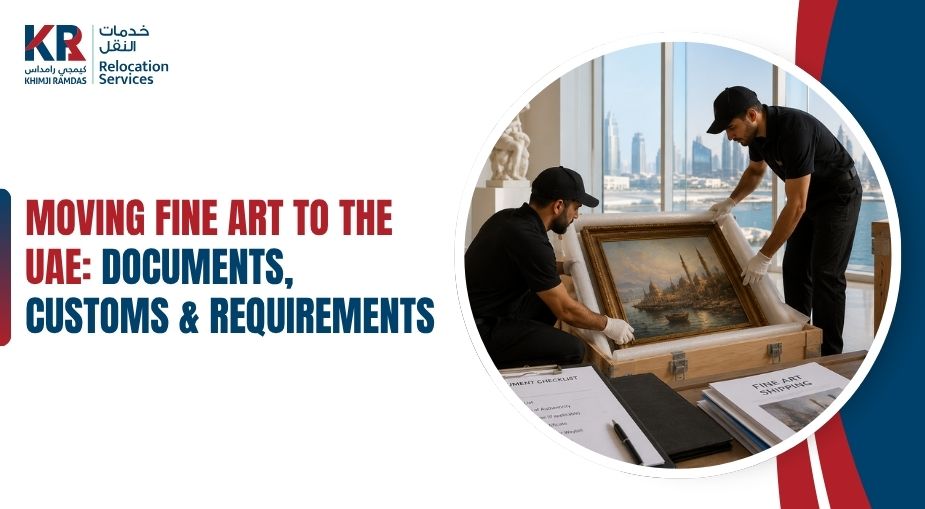
Moving fine art to the UAE is not simply a matter of arranging transport; the documentation, valuation and customs preparation can determine whether a shipment arrives smoothly or faces avoidable delays. A painting, sculpture, antique or collectible may require a clearer paper trail than ordinary household goods, particularly when its value, age, origin or cultural importance is not immediately obvious.
This guide explains what to prepare before fine art shipping to the UAE, how ownership and provenance records support customs review, what insurance documentation should show, and which additional questions may arise for antiques or culturally significant pieces. It focuses on the documentation and customs side of the move, while leaving detailed packing, crating and handling methods to specialist planning with your appointed fine art movers.
Moving Fine Art to the UAE: What Must Be Established First
Before any paperwork is submitted, you need to establish exactly what is being moved, who owns it, where it came from and why it is entering the UAE. Those points sound straightforward, but they are often unclear when a collection has been assembled over many years, inherited, bought through different galleries or divided between family members.
A customs file is easier to review when every item can be matched to a consistent description, value and ownership story. The aim is not to create unnecessary paperwork. It is to remove uncertainty before the shipment reaches the destination.
Create an Item-Level Inventory
Begin with an inventory that identifies each object separately. Avoid descriptions such as “artwork”, “decorative item” or “old painting” on their own. A more useful record might identify the artist, title or subject, medium, dimensions, date or estimated period, country of origin and quantity.
For example, “oil painting” is less helpful than “oil on canvas, landscape, attributed to [artist], approximately 80 by 60 centimetres, acquired in 2018”. If the artist or date is unknown, say so rather than guessing. An honest description supported by available evidence is safer than an impressive but unverified attribution.
Photographs should correspond to inventory numbers. Take clear images of the front, reverse, signature, labels, certificates, maker’s marks and any existing damage. These images can help distinguish one piece from another and provide a condition reference before handling begins.
Separate Personal, Commercial and Institutional Shipments
The reason for import can affect the documents and process required. A private collector moving residence may be dealing with personal effects, while a gallery, museum, auction business or corporate collection may be importing for exhibition, sale, loan or temporary use. Art returning after an exhibition may also have a different documentary history from a newly purchased item.
Do not assume that a shipment is treated as ordinary household goods simply because it travels with a household move. Fine art may need to be declared and assessed according to its nature, value and purpose. The correct classification should be discussed with the relocation coordinator and the relevant customs or clearance specialists before dispatch.
Resolve Inconsistencies Before Collection
Common problems include an invoice showing one value while an insurance schedule shows another, a certificate naming a different owner, or an inventory using a different spelling from the purchase record. These issues may be explainable, but they take time to resolve when the shipment is already in transit.
At Khimji Ramdas Relocation Services, the practical starting point is a document review alongside the item inventory. This allows the team to identify missing information early and coordinate with the appropriate parties. It does not replace the decisions of customs authorities, insurers or other government bodies; it helps you approach those decisions with a more coherent file.

Tell us about your move and get a personalized quote based on your requirements.
Documents That Support Valuation, Ownership and Provenance
The strongest fine art documentation connects four things: the object itself, its value, its ownership and its history. No single document proves every point. Instead, customs brokers, insurers and other involved parties may rely on a combination of records, depending on the shipment and the authorities concerned.
Requirements can vary by origin country, destination, item type, shipment purpose and the circumstances of the owner. Prepare the records you have, identify gaps clearly and obtain professional advice where the history or value of an item is uncertain.
Valuation Records Should Be Defensible
A declared value should be supported by evidence appropriate to the object. Depending on the circumstances, that may include a purchase invoice, gallery invoice, auction record, recent appraisal, insurance valuation, replacement-cost assessment or documentation of an inheritance or gift.
A purchase price from many years ago may not reflect current insurance value. Conversely, a broad insurance value may not be the same as a customs value or a sale price. These figures can serve different purposes, so they should not be substituted for one another without advice.
For high-value pieces, an independent appraisal can be useful, especially where there is no recent transaction record. The appraisal should identify the object clearly, explain the basis of the valuation and state the date on which it was prepared. Keep earlier appraisals as well if they help show how the value was established over time.
Ownership and Provenance Records
Ownership records help show that the person or organisation shipping the piece has a legitimate interest in it. Useful documents may include purchase agreements, invoices, auction confirmations, gallery correspondence, inheritance documents, donation records, loan agreements or prior import and export paperwork.
Provenance is the documented history of an artwork or object. It may include previous owners, exhibitions, publications, sale records and certificates of authenticity. Provenance is particularly important for older works, archaeological objects, religious items and pieces that may have originated in regions with restrictions on cultural property.
A complete provenance history is not always available, especially for inherited family collections. That does not automatically prevent relocation, but missing history should be acknowledged. Do not manufacture a continuous ownership story from assumptions. Instead, gather family records, old photographs, correspondence and prior certificates, and ask a qualified specialist to assess any unresolved concerns.
Insurance Documentation for Shipping
Insuring artwork for shipping requires more than listing a total collection value. The policy or certificate should identify the covered items, their agreed or declared values, the movement being insured and the relevant locations or stages of transit. You should also understand exclusions, deductibles, valuation basis, claims procedures and whether cover applies during temporary storage.
Ask whether the policy covers the actual journey, handling, customs-related delay, storage between transport stages and any period before final delivery. Coverage terms vary, and a standard household contents policy may not provide the protection expected for fine art.
Make sure the condition report, inventory and photographs are retained with the insurance file. If a piece already has a scratch, repaired frame or unstable finish, record it before collection. A clear pre-move record makes it easier to distinguish pre-existing condition from a new issue and supports a more orderly claims process.
Keep a Document Pack and a Digital Backup
Prepare one master file with an item schedule, photographs, invoices, appraisals, certificates, ownership evidence, insurance records and any correspondence about import or export. Use the same item numbers across every document.
Keep a digital copy in a secure location, but do not rely only on a phone or an email inbox. Larger files, restricted access and document version confusion can create practical problems. A named contact should know which version is current and be able to provide supporting records promptly if a clarification is requested.

Discuss your moving requirements with our team and find the right support for your move.
Customs Considerations for Fine Art Shipping to the UAE
Customs preparation begins with accurate classification and a clear explanation of the shipment. The UAE destination is important, but so are the country of export, the route, the ownership situation and whether the movement is permanent, temporary, commercial or connected to a change of residence.
Customs authorities make the final decisions on declarations, inspections, classification, duties, taxes and release. A fine art logistics provider or customs specialist can prepare and coordinate information, but cannot guarantee an official outcome. Requirements may also differ between emirates, ports, free zones and shipment circumstances, so the applicable process should be confirmed before dispatch.
Match the Customs Description to the Physical Item
The customs description should be specific enough to explain what the item is without overstating facts. Include the object type, material, artist or maker where known, approximate age, country of origin, quantity and value. If the item is an antique, state the estimated period only when supported by available evidence.
Descriptions should also be consistent across the commercial invoice, packing list, valuation, insurance schedule and transport documents. If one document describes a work as a modern decorative object and another calls it a nineteenth-century original, the discrepancy may prompt additional questions.
The relevant classification code should be determined by the responsible customs professional based on the actual item and movement. Do not select a code solely because it appears to attract a lower charge or seems broadly similar.
Prepare for Questions About Import Purpose
A shipment may be entering the UAE for permanent residence, a sale, an exhibition, a gallery display, a loan, restoration or temporary storage. The purpose can influence which documents are relevant and whether additional arrangements are needed.
For a private relocation, evidence of the move and ownership may be relevant. For a gallery or exhibition, the parties may need records showing the temporary nature of the movement and the relationship between the owner, consignee and receiving institution. A return shipment may require documents that connect it to the original export.
Explain the intended use before the shipment is collected. Changing the purpose or consignee after dispatch can be more complicated than agreeing the correct approach at the planning stage.
Understand Possible Inspection and Clarification Requests
Fine art may be inspected or held for clarification. This is not necessarily an indication that something is wrong; authorities may need to verify a description, value, origin, permit or supporting document. However, the time and cost impact can be significant if the file is incomplete or the owner cannot respond quickly.
Keep the owner, consignee, customs representative and relocation coordinator aligned on who will answer questions. A fast response is more likely when the person handling the query can immediately locate the relevant invoice, appraisal, photograph or provenance note.
Do not arrange for the shipment to be opened casually at the destination. Inspection and unpacking should be coordinated with the parties responsible for customs clearance, insurance and specialist handling. The objective is to preserve control of the item while meeting the authority’s requirements.
Duties, Taxes and Other Charges
Whether duties, taxes, fees or other charges apply depends on the shipment’s classification, value, purpose, origin, destination arrangement and applicable rules at the time. There may also be charges connected with inspection, storage, demurrage or additional handling if clearance takes longer than expected.
A responsible quotation should distinguish confirmed service charges from amounts that depend on customs or third-party decisions. Ask what is included, what is estimated, who is responsible for payment and what happens if customs requests additional documentation. This is especially important for valuable pieces, because a small description error can have a disproportionate financial effect.
Khimji Ramdas Relocation Services can support the coordination of fine art moving in the UAE by helping organise the shipment information and the parties involved. Any official approval, assessment or release remains subject to the relevant authority and the specific facts of the shipment.
Our moving experts are here to assist you.
Antiques and Culturally Significant Items Need Extra Review
Age alone does not determine whether an artwork is restricted or sensitive, but older and culturally significant objects deserve an earlier review. A carved figure, manuscript, religious object, archaeological fragment, traditional textile or historic weapon may raise questions that do not arise for a contemporary print or recently purchased painting.
The safest approach is to identify potentially sensitive pieces before packing or booking. Waiting until a shipment is at the border can create avoidable uncertainty, particularly when the owner has never considered whether an item has cultural-property implications.
Look Beyond the Label “Antique”
An item described informally as an antique may be a period object, a later reproduction, a restored piece or an item with uncertain age. The distinction matters. Ask a qualified appraiser or relevant specialist to clarify what can reasonably be stated about its date, origin, maker and cultural context.
Keep restoration reports, conservation notes, previous export documents and certificates of authenticity where available. For objects made from protected or regulated materials, such as certain timbers, animal products or minerals, additional rules may apply depending on the item and route. Do not assume that a decorative object is exempt simply because it is small or privately owned.
Check Export Requirements in the Country of Origin
The UAE destination is only one part of the compliance picture. The exporting country may have its own rules for cultural property, antiques, artwork, protected materials or objects above a particular age or value. Those requirements must be checked with the relevant authority or a qualified adviser in the country of export.
A relocation company can help identify the question and coordinate documents, but it should not be treated as the authority that grants an export permit or decides whether an object may leave its country of origin. If an export certificate, licence or other approval is required, obtain it before collection or follow the process advised by the responsible authority.
Give High-Risk Items More Planning Time
If provenance is incomplete, the object is unusually old, the origin is sensitive or the value is disputed, build time into the plan for expert review. The right outcome may be to move the item later, use a different documentary approach or decide not to ship it until its status is clear.
This is also where specialist art storage can help. If a piece needs to remain secure while documentation is reviewed, temporary fine art storage may provide a controlled pause rather than forcing an uncertain shipment into the next available departure. Storage arrangements, insurance and access conditions should be confirmed for the specific items involved.
Consider the Receiver’s Responsibilities
The UAE recipient should be identified accurately and should understand the shipment’s contents and declared purpose. For a private home, that may mean confirming the owner’s details and delivery address. For a gallery, office, hotel or institution, it may involve coordinating receiving access, internal approvals and a person authorised to accept the work.
The receiving party should not sign for visibly damaged or incomplete delivery without recording the condition and notifying the relevant parties. A proper handover links the customs record, transport record, insurance file and final condition report.
Making the Documentation Process Practical
Good paperwork is not about producing the largest possible file. It is about producing a coherent file that can be understood by someone who has never seen the collection. A practical process reduces the risk of contradictory descriptions, missed approvals and last-minute decisions.
Use a Pre-Move Review Meeting
Before confirming the movement, review the collection item by item with the owner or collection manager. Confirm the destination, consignee, purpose, estimated values, available provenance, insurance position and any items that may need special authority review.
A useful review separates confirmed facts from information still being checked. For instance, “purchased from a London gallery in 2019” is a documented fact if supported by an invoice, while “probably eighteenth century” is an assessment that may need specialist confirmation.
Use One Master Schedule
A master schedule should be updated when a value, description, owner or destination detail changes. Give every item a unique reference and use it on photographs, documents and correspondence. If a collection includes framed and unframed works, identify the artwork and its frame clearly so their values and condition are not confused.
For collections with many pieces, a simple table can include the following fields: item number, artist or maker, title or description, medium, dimensions, estimated date, origin, owner, value, insurance reference, provenance documents and customs notes. The exact fields should reflect the shipment rather than becoming a bureaucratic exercise.
Choose a Provider That Can Coordinate, Not Just Transport
When comparing fine art movers, ask how they handle documentation, customs coordination, insurance information, condition records and exceptions. A company that only discusses collection and delivery may not be addressing the main risk in a complex international art move.
Ask practical questions:
- Who checks the inventory against the shipping documents?
- Who contacts the customs representative if a clarification is requested?
- How are high-value or sensitive items identified internally?
- Can temporary art storage be coordinated if clearance or delivery timing changes?
- Which matters remain the owner’s responsibility, such as appraisals, permits or official declarations?
The answers should be specific without promising control over customs or insurance outcomes. At Khimji Ramdas Relocation Services, our role is to support and coordinate the relocation process around the client’s collection, while the owner, insurer, appraiser and authorities retain responsibility for their respective decisions.
Allow for Uncertainty Without Losing Control
No document review can eliminate every question. Values change, provenance can be incomplete and authorities may request information that was not anticipated. The goal is to identify the likely pressure points and make the response process orderly.
Keep contact details current for the owner, consignee, insurer, customs representative and any appraiser involved. Confirm who may approve additional handling, storage or documentation costs. If an item is irreplaceable, do not rely on a rushed verbal decision when a written instruction can prevent misunderstanding.
When Art Storage Is Part of the Plan
Some owners need art storage before shipment, during a residence transition or after arrival in the UAE. Storage should not be treated as an invisible gap between transport stages. Confirm the storage location, access arrangements, insurance basis, inventory control and release authority for each item.
If documentation is still being completed, storage can protect the schedule by keeping the piece secure while the owner obtains an appraisal or checks an export requirement. It should not, however, be used to avoid a required approval or customs declaration. Khimji Ramdas Relocation Services can discuss storage and relocation coordination where those services fit the collection and project requirements.
Wrapping Up
Moving fine art to the UAE becomes more manageable when the documentation is prepared as carefully as the physical movement. Start with an item-level inventory, then connect each piece to evidence of value, ownership, provenance, insurance and intended import purpose. Treat antiques, protected materials and culturally significant objects as early-review items rather than last-minute exceptions.
Customs authorities and insurers may require different information, and requirements can vary by route, shipment type and individual circumstances. That is why a single consistent document pack, early specialist advice and clear responsibility between the owner, appraiser, insurer, customs representative and relocation provider matter so much.
If you are planning fine art shipping or fine art moving in the UAE, Khimji Ramdas Relocation Services can help coordinate the practical relocation process, documentation review and related storage arrangements where appropriate. The best next step is to prepare your inventory and available records before requesting a project assessment, so the route, risks and outstanding questions can be discussed from the beginning.


FAQs - Moving Fine Art to the UAE
What documents are needed when moving fine art to the UAE?
Prepare an itemised inventory, photographs, invoices, valuation or appraisal records, ownership and provenance documents, insurance details and transport paperwork. Requirements vary by item, route and import purpose.
How should artwork be valued for UAE customs and insurance?
Support the declared value with a purchase invoice, auction record, recent appraisal or other reliable evidence. Customs value and insurance value may serve different purposes, so confirm the correct basis for each.
Do I need proof of provenance when shipping artwork to the UAE?
Provenance may be important for valuable, historic, inherited or culturally sensitive pieces. Keep purchase records, certificates, exhibition history and prior export documents, or disclose clearly where the history is incomplete.
Can antiques be imported into the UAE with ordinary household goods?
Not always. Age, origin, materials, cultural significance and shipment purpose may trigger additional checks or approvals. Review potentially sensitive antiques before dispatch with the relevant authority or qualified specialist.
Does artwork insurance cover customs delays and temporary art storage?
It depends on the policy. Confirm whether cover applies during transit, customs-related storage, temporary art storage, handling and delivery, and check exclusions, deductibles and the claims procedure before shipping.
Can fine art movers handle UAE customs clearance for my collection?
Fine art movers can help organise information and coordinate customs representatives, but authorities make the final decisions on classification, inspection, duties, taxes and release. Requirements depend on the shipment.
How can Khimji Ramdas Relocation Services support fine art moving in the UAE?
Khimji Ramdas Relocation Services can support and coordinate fine art relocation, documentation preparation and related storage arrangements where suitable. Appraisals, insurance decisions, permits and official customs outcomes remain with the responsible parties.
Explore Our Most Relevant Articles
With a dedicated single point of contact offering comprehensive, tailored solutions, streamlined processes, and a network of suppliers, we ensure a superior relocation experience. Our commitment to excellence ensures that every aspect of the relocation process is efficiently managed, delivering satisfaction to our clients.

Best Time to Move in Dubai: Know Best Weather, Costs & Tips
Discover the best time to move in Dubai by comparing weather, costs, demand, weekdays, weekends and building access for a smoother local move.
UAE Car Customs Clearance: Common Delays and How to Avoid Them
Car customs clearance in the UAE can face avoidable delays. Learn which documents cause holds and how to prepare your vehicle shipment before arrival.

Pet Import Permits for the UAE: Step-by-Step Guide (2026)
Learn how to arrange a UAE pet import permit in 2026, including microchips, vaccinations, documents, application steps, timing and common mistakes.