40ft Container Dimensions: Can a UAE Household Move Fit Inside?
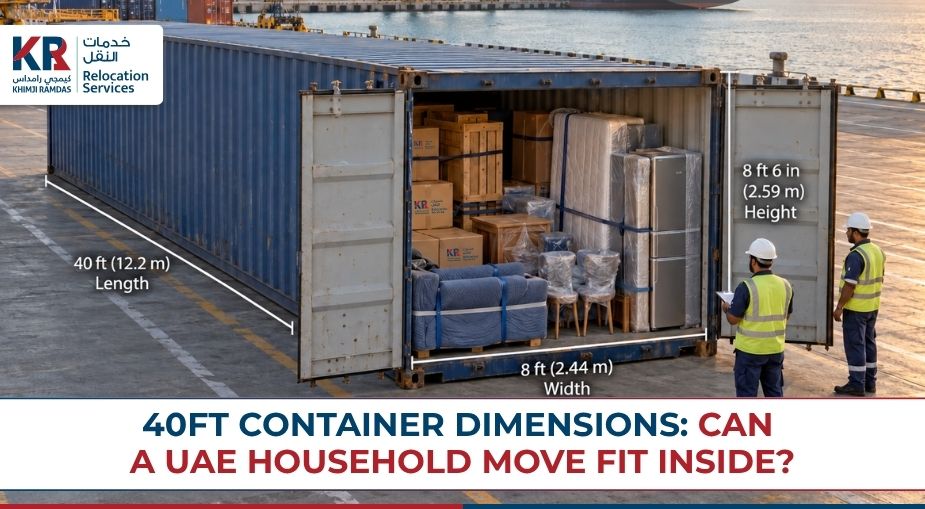
40ft container dimensions can determine whether your UAE household move to Qatar fits into one shipment or needs a different loading plan.
The external size is only part of the decision: furniture shape, packing method, access at both properties, restricted items, and the space lost around irregular belongings all affect the final result.
For tenants moving from the UAE to Qatar, this guide explains standard and high-cube container measurements, compares them with 20ft options, and shows how professional international movers assess volume.
It also provides a practical, stage-by-stage checklist covering tenancy handover, utilities, documents, inventory, packing, transport coordination, customs paperwork, and delivery planning.
Understanding 40ft Container Dimensions for a UAE Household Move
A container is measured in several different ways, and confusing those measurements is one of the most common causes of unrealistic moving estimates. The external dimensions help determine transport and access requirements.
The internal dimensions and cubic capacity determine how much household property can actually be loaded. The door opening affects whether large furniture can enter without dismantling.
When checking 40ft container dimensions, a standard 40ft dry container is commonly close to the following measurements, although exact specifications can vary by equipment provider:
- External length: approximately 12.19 metres
- External width: approximately 2.44 metres
- External height: approximately 2.59 metres
- Internal length: approximately 12.03 metres
- Internal width: approximately 2.35 metres
- Internal height: approximately 2.39 metres
- Nominal internal volume: approximately 67 cubic metres
When checking 40ft container dimensions, these are planning figures, not a guaranteed loading allowance. The container walls, doors, floor structure, lashing requirements, packing materials, and safe weight distribution all reduce the practical space available for belongings.
Standard Versus High-Cube Containers
A 40ft high cube container usually has the same approximate length and width as a standard 40ft unit but provides additional height.
Its external height is commonly about 2.90 metres, with an internal height close to 2.69 metres and a nominal capacity of roughly 76 cubic metres. Exact dimensions should be confirmed against the container specification offered for your shipment.
To make sense, the extra height can help with tall wardrobes, boxed appliances, framed artwork, or carefully stacked cartons. It does not automatically mean that every household should choose a high cube.
If the shipment is constrained by weight, property access, port equipment, road restrictions, or the height of the loading area, the additional volume may not be useful.
Why Cubic Capacity Is Not the Same as Usable Space
A catalogue capacity assumes efficient rectangular loading. A household move rarely consists of identical boxes. Sofas, bed frames, bicycles, garden equipment, lamps, mirrors, and children’s items create voids that cannot always be filled safely. Protective wrapping also increases the outer dimensions of furniture.
For example, a family comparing 40ft container dimensions may own enough furniture to occupy a theoretical 60 cubic metres, but the shipment may require more space because a sectional sofa cannot be stacked like cartons.
Conversely, a household with many uniform cartons may use the container more efficiently than a household with fewer but larger items.
A detailed survey, whether completed in person or through suitable remote information, helps identify what is being moved, what will be dismantled, and which items need specialist protection.

Tell us about your move and get a personalized quote based on your requirements.
Will Your UAE Household Fit in a 40ft Container?
The practical answer depends on the household profile rather than the property’s advertised number of bedrooms. A four-bedroom villa can be lightly furnished, while a compact apartment can contain a large volume of stored possessions.
The correct decision comes from measuring the shipment after exclusions, disposal, sale, and packing assumptions have been considered.
Start With an Itemised Inventory
Record the main dimensions of substantial items and identify anything that cannot be dismantled. Include storage rooms, balconies, garages, lofts, outdoor areas, and items currently kept with family or in a separate storage unit.
Do not overlook small categories that accumulate quickly: books, toys, kitchen equipment, tools, sports gear, seasonal decorations, and archive boxes. A single cupboard may be insignificant, but several partially filled cupboards can add a meaningful volume to an international shipment.
Separate the inventory into four groups:
- Moving: items intended for the Qatar residence; compare their packed volume with 40ft container dimensions.
- Selling or donating: items that will leave before packing
- Discarding or recycling: damaged, obsolete, or prohibited items
- Deciding later: items that need a cost or sentimental-value review
This process is not merely administrative. It prevents paying to ship low-value items and gives the moving team a realistic basis for packing materials, labour, vehicle planning, and freight forwarding arrangements.
Compare the 20ft and 40ft Options
A 20ft container is commonly close to 5.90 metres internally, 2.35 metres wide, and 2.39 metres high, with a nominal volume of about 33 cubic metres. As with 40ft container dimensions, these figures vary by equipment and should be confirmed before booking.
A 20ft container may suit a smaller apartment, a partially furnished home, or a shipment after substantial decluttering. It can also be a sensible choice when the inventory is well below the practical capacity of a 40ft unit.
A 40ft container generally gives more volume, but filling it with items that are inexpensive or readily replaceable in Qatar may not be financially sensible.
For a comparison of 40ft container dimensions, a shared or consolidated service may be considered in some circumstances, but its availability, routing, handling process, schedule, and suitability depend on the shipment and the provider.
It should not be assumed that consolidation is always cheaper or faster. Extra handling may also be less desirable for fragile, high-value, or time-sensitive property.
When a High Cube May Help
To make sense of 40ft container dimensions, a 40ft high cube container can be useful when the shipment has substantial carton volume or tall items that would otherwise require inefficient stacking.
It is particularly worth discussing when the inventory includes many standard cartons and the access conditions allow the equipment to be handled safely.
High-cube capacity is not a solution for poor inventory control. If the shipment contains heavy machinery, dense books, stone furniture, or large quantities of metal, the weight limit may be reached before the cubic space is filled.
The shipping line, transport provider, and relevant authorities determine applicable weight and equipment conditions, so those details should be checked for the specific movement.
A Practical Loading Example
When checking 40ft container dimensions, imagine a UAE tenant moving a furnished three-bedroom apartment. The household has two beds, a dining set, a sofa, wardrobes, kitchen contents, children’s furniture, bicycles, and approximately 100 cartons.
The result might fit comfortably in one 40ft container if furniture is dismantled, cartons are standardised, and the inventory excludes items left behind.
With 40ft container dimensions in mind, if the same household adds a large outdoor set, a packed storeroom, a piano, workshop tools, and several oversized cabinets, the nominal capacity may become misleading.
A second container, a smaller move after editing the inventory, or a different shipment plan may need to be evaluated. An experienced surveyor should explain the assumptions instead of presenting a capacity figure as a certainty.

Discuss your moving requirements with our team and find the right support for your move.
What Should You Organise Before Moving From the UAE to Qatar?
For decisions involving 40ft container dimensions, a cross-border household move can be delayed by tasks that are not physically part of packing.
When relocating to Qatar from UAE, you also need to manage tenancy handover, utility closure, document validity, building permissions, destination access, and customs requirements. Start with a written schedule and assign responsibility for every task, even if a relocation coordinator is managing the arrangements.
Several Weeks Before Departure: Establish the Move Plan
Confirm the intended departure window, Qatar address or temporary accommodation, preferred delivery timing, and the status of your UAE tenancy. If the destination home is not ready, discuss whether storage or delayed delivery is available and what additional conditions may apply.
After verifying 40ft container dimensions, contact your UAE landlord or property manager to confirm the notice period, inspection process, reinstatement obligations, key handover, and deposit procedure.
Request written confirmation of the expected handover standard. A move can be physically complete while the tenancy remains unresolved because of cleaning, repairs, access cards, or outstanding utility matters.
Begin checking official information for both countries. Requirements can vary according to nationality, visa status, residence status, shipment contents, ownership, and the current rules of the relevant authority.
Use official UAE and Qatar government portals, customs authorities, embassies or consulates where relevant, and your appointed moving or freight forwarding team for shipment-specific guidance.
Two to Three Weeks Before Departure: Reduce and Document
For a comparison of 40ft container dimensions, finalise the inventory and decide what will not travel. Obtain written permission before including items that may be controlled, restricted, or subject to special documentation.
Examples can include medication, food, plants, animal products, weapons or replicas, certain electronic equipment, and valuable or culturally sensitive objects. Do not rely on a generic internet list because requirements may change by country, authority, and item classification.
Collect documents in a secure, accessible file. Depending on your situation, this may include passports, residence or entry documents, Qatar address details, tenancy information, insurance records, purchase evidence for valuable items, and any documents requested by the destination authorities or shipping provider.
Keep originals with you unless an authority specifically requires otherwise, and maintain encrypted digital copies.
To make sense of 40ft container dimensions, book building access at the UAE residence. Many apartment towers and managed communities require advance notice, a loading bay reservation, lift protection, security registration, or a move-out permit.
Ask whether the collection vehicle can reach the loading area and whether there are height, timing, or parking limits.
One Week Before Departure: Close the UAE Home Properly
Arrange final utility readings and closure or transfer of electricity, water, telecommunications, cooling, and other accounts according to each provider’s process. Retain final bills, closure references, clearance confirmations, and photographs of meter readings where appropriate. The exact process varies by emirate, provider, tenancy contract, and account type.
While reviewing 40ft container dimensions, complete the handover cleaning and repairs required by the tenancy agreement. Photograph each room, fixed installation, meter, appliance, and returned access device. Record the date and recipient when keys, remotes, parking cards, or building passes are handed back.
At this stage, the shipment inventory should be closed. Last-minute additions are a frequent source of inaccurate volume estimates, missing labels, and loading-day disputes. Tell the relocation coordinator about any change before packing starts rather than placing unlisted items into a carton.
Packing and Collection Day: Protect the Shipment and the Property
After verifying 40ft container dimensions, keep passports, medicines, chargers, essential clothing, work equipment, valuables, and documents separate from the shipment. Prepare a small arrival bag because sea freight delivery may not coincide with the day you leave the UAE.
Before the crew arrives, remove personal items from drawers and cupboards, disconnect appliances where safe, and identify items requiring special handling.
The packing team should be able to distinguish what is moving from what is being left behind. Ask how cartons will be labelled, how fragile items will be recorded, and how the final inventory will be reconciled.
When checking 40ft container dimensions, protect the UAE property as well as the goods. Lift protection, floor coverings, door protection, and careful movement through narrow areas can reduce damage and help satisfy building requirements.
If access changes because of a lift outage, road obstruction, or security restriction, notify the coordinator immediately; improvised loading arrangements can affect safety and timing.
Our moving experts are here to assist you.
How to Coordinate Customs, Sea Freight, and Qatar Delivery
For a comparison of 40ft container dimensions, sea freight is only one part of an international move. The shipment must also be documented, accepted for export, carried, cleared at destination, and delivered to a property that is ready to receive it.
No moving company can guarantee a government or customs decision, and the applicable requirements may change according to the origin, destination, shipment type, contents, and current authority instructions.
Before the Container Is Sealed
For decisions involving 40ft container dimensions, review the inventory carefully and check that names, addresses, contact details, and document references are consistent. Inconsistencies between the shipment inventory, identity documents, residence information, and customs paperwork can create questions at destination.
Ask the appointed international mover which documents it needs from you and which documents are prepared by the shipping or destination agents.
Clarify whether originals, copies, translations, attestations, or additional evidence may be requested for particular items. Do not pack documents that you may need for travel, tenancy, immigration, or customs appointments.
For decisions involving 40ft container dimensions, confirm the planned container type, loading method, seal recording process, and how you will receive the final packing inventory.
If a container is shared or the shipment is handled through a different freight arrangement, ask how identification, access, and delivery coordination will work.
Customs Preparation for Qatar
To make sense of 40ft container dimensions, verify current Qatar import and customs requirements through official Qatar government and customs sources before packing.
Requirements can depend on whether the goods are personal effects, whether the importer has the relevant status, the description and age of the goods, and whether particular categories require approval or supporting evidence.
Your moving company can help prepare, organise, and coordinate the shipment file, but it does not control customs inspections, duty assessments, release decisions, or other government outcomes.
If customs requests clarification, respond promptly and provide only accurate information. Never describe new goods as used personal effects or omit items to simplify a declaration.
After verifying 40ft container dimensions, for special categories such as vehicles, pets, medication, plants, food, firearms, antiques, artwork, or business equipment, obtain specific guidance before the shipment is packed.
These items may follow different processes from ordinary household goods and should not be assumed to travel under the same paperwork.
Destination Arrangements in Qatar
For decisions involving 40ft container dimensions, confirm the delivery address, building name, unit number, contact person, access hours, lift dimensions, parking rules, loading bay, and any move-in permit.
If the property is in a compound or high-rise building, ask the landlord or building management about restrictions on trucks, external lifts, protective materials, and delivery times.
Measure the entrance, corridors, stairwells, and lift before dispatch if the residence is already available.
A container may reach Qatar successfully but still face a delivery problem if a sofa cannot turn through a corridor or the vehicle cannot enter the property. Photographing access points can help the relocation team plan dismantling and reassembly.
When using 40ft container dimensions to plan a load, if you will use temporary accommodation, confirm the storage and delivery plan in writing.
Make sure you understand whether storage is at origin, in transit, or at destination; how charges are calculated; whether access is restricted; and how notice for final delivery must be provided. These details should be confirmed in the service documentation rather than assumed.
Why Sea Freight Timing Needs Flexibility
When using 40ft container dimensions to plan a load, ocean transport involves vessel schedules, port operations, transhipment arrangements where applicable, customs processing, documentation review, and local delivery conditions. The published sailing or estimated transit information is not the same as a guaranteed date for delivery into your home.
Build flexibility into accommodation, school arrangements, work equipment, and essential purchases. Keep enough clothing, household basics, and important documents with you for the period before delivery.
Khimji Ramdas Relocation Services can support the coordination of an international move and destination delivery planning, while the actual timing remains subject to carriers, ports, authorities, and property readiness.
Read also: Cost of Living in Dubai: A Relocation Budget by Household Guide
A UAE-to-Qatar Moving Checklist From Preparation to Delivery
To make sense of 40ft container dimensions, use the following checklist as a working document, then adapt it to your tenancy, residence status, shipment contents, and Qatar address. Confirm current rules with official sources because government requirements and provider procedures can change.
Several Weeks Before Departure
- Confirm your Qatar accommodation, address, move-in date, access conditions, and temporary storage needs.
- Review the UAE tenancy contract, notice requirements, inspection process, repairs, cleaning, and deposit procedure.
- While reviewing 40ft container dimensions, request a moving survey and create a room-by-room inventory, including storage and outdoor areas.
- Decide what will be sold, donated, discarded, stored, or shipped.
- Check official Qatar customs and entry guidance for personal effects and any special items.
- Check passport, visa, residence, identity, and travel-document validity for every household member.
- Ask the building manager about lift bookings, loading bay reservations, move-out permissions, and working hours.
- Separate documents and valuables that must travel with you rather than in the sea shipment.
2 to 3 Weeks Before Departure
- For a comparison of 40ft container dimensions, confirm the selected container or shipment method against the measured inventory.
- Ask whether a standard 40ft container, 40ft high cube, 20ft container, or another arrangement is appropriate.
- Finalise the packing date, collection address, destination contact, and communication process.
- Prepare the inventory and supporting evidence for valuable, regulated, or unusual items.
- Contact UAE utility, telecommunications, cooling, and other service providers about closure, transfer, final readings, and clearance.
- After verifying 40ft container dimensions, arrange vehicle, pet, plant, medication, food, artwork, or other special-item procedures separately where required.
- Confirm whether Qatar building management requires a move-in permit, insurance document, lift booking, or vehicle details.
- Take photographs of the UAE property condition, meters, appliances, access devices, and items being left behind.
1 Week Before Departure
- Complete decluttering and do not add unlisted goods without notifying the moving coordinator.
- Pack an arrival bag with clothing, medicines, chargers, toiletries, documents, children’s essentials, and work equipment.
- To make sense of 40ft container dimensions, confirm the final inventory, labels, carton numbering, fragile items, and dismantling requirements.
- Complete tenancy repairs, cleaning, inspection, and key or access-card arrangements.
- Record utility closure references and retain final bills or clearance confirmations.
- Reconfirm the packing team’s arrival time, vehicle access, building contact, and emergency contact details.
- Check the Qatar address, telephone numbers, destination contact, and property readiness once more.
Packing, Loading, and Departure
- When checking 40ft container dimensions, keep passports, cash, jewellery, essential medication, and critical documents outside the shipment.
- Identify items that require specialist packing or cannot be loaded under the agreed service.
- Check that the final inventory reflects what was packed and that the container seal information is recorded.
- Protect floors, walls, lifts, doors, and common areas in accordance with building requirements.
- Confirm who is responsible for sending documents to the destination agent or customs representative.
- Keep copies of the service agreement, inventory, insurance or valuation documents, contact list, and shipment references.
- Once 40ft container dimensions and the shipment plan are confirmed, photograph the empty UAE residence and return keys, remotes, parking cards, and access devices as agreed.
While the Shipment Is in Transit
- Monitor communications from the moving coordinator, carrier, destination agent, or customs representative.
- Respond quickly if clarification or additional documentation is requested.
- Do not assume an estimated sailing, arrival, or delivery date is guaranteed.
- Confirm that your Qatar accommodation, utilities, internet, school arrangements, and building access are progressing.
- While reviewing 40ft container dimensions, recheck the official Qatar customs or government guidance if your residence status, address, or shipment contents change.
- Maintain a list of essential purchases and temporary accommodation needs in case delivery is later than expected.
Before Delivery in Qatar
- Confirm customs release status through the responsible agent and complete any required customer action.
- Reconfirm delivery date, vehicle access, parking, lift booking, permitted hours, and contact person.
- Measure tight access points and remove obstacles from corridors, entrances, and rooms.
- Confirm where cartons and furniture should be placed to avoid unnecessary handling.
- After planning the shipment around 40ft container dimensions, arrange installation or connection appointments for utilities and essential services.
- Keep the inventory available for checking when goods arrive.
Delivery and Aftercare
- Walk through the property with the delivery team and identify where each major item should go.
- Check cartons and furniture against the inventory before signing delivery paperwork.
- Record visible damage or missing items promptly according to the agreed claims process.
- Confirm that furniture assembly, unpacking, debris removal, or appliance services are included before requesting them.
- Keep the agreed 40ft container dimensions, customs, shipping, inventory, tenancy, and delivery records in one file.
- Update your Qatar address with employers, schools, banks, insurers, and government or service providers as applicable.
Khimji Ramdas Relocation Services can be considered for the international moving stage when you need help connecting inventory planning, packing, export coordination, sea freight services from Dubai, destination arrangements, and delivery support.
Review the International Moving Services information and Qatar destination guidance available from Khimji Ramdas Relocation Services, then confirm the scope, assumptions, exclusions, and documentation requirements for your specific move.
Wrapping Up
The reliable answer comes from a measured inventory, realistic packing assumptions, furniture access checks, weight awareness, and a clear decision about what is genuinely worth shipping to Qatar.
Begin with decluttering and a room-by-room survey, then coordinate tenancy handover, utilities, documents, building access, customs preparation, and destination delivery as one connected plan. Verify current requirements through official UAE and Qatar sources, particularly for special items and personal circumstances.
When the move involves a full household, complex access, fragile possessions, or limited time, Khimji Ramdas Relocation Services can help organise the international moving process and explain the practical trade-offs between container options.
The best next step is to prepare your inventory and request a shipment assessment based on the actual goods rather than relying on bedroom count or nominal container capacity.


FAQs - 40ft Container Dimensions for Household Moves
What are the standard 40ft Container Dimensions?
A standard 40ft container is approximately 12.19m long, 2.44m wide and 2.59m high externally, with about 67 cubic metres of nominal internal capacity. Exact specifications vary.
How much furniture fits in a 40ft container from the UAE to Qatar?
A 40ft container may suit a furnished family home, but the result depends on furniture size, cartons, packing method, weight and access. A measured inventory is more reliable than bedroom count.
What are 40ft high cube container dimensions?
A 40ft high cube is commonly about 2.90m high externally and provides roughly 76 cubic metres of nominal internal volume. Confirm the actual equipment specifications before booking.
Should I choose a 20ft or 40ft container for my UAE move?
For a comparison of 40ft container dimensions, a 20ft container may suit a smaller or heavily decluttered home, while a 40ft container offers more volume for a furnished household. Compare the measured inventory, weight and shipping cost.
What documents are needed for moving household goods from the UAE to Qatar?
For decisions involving 40ft container dimensions, documents vary by shipment, residence status, contents and current authority rules. Check official Qatar customs guidance and provide the mover with accurate identity, address and inventory information.
How early should I prepare a UAE-to-Qatar container move?
Start several weeks before departure to survey belongings, end the tenancy, close utilities, check documents and arrange building access. Allow additional flexibility for customs and sea freight coordination.
Can Khimji Ramdas Relocation Services help with a 40ft household move to Qatar?
When checking 40ft container dimensions, Khimji Ramdas Relocation Services can support inventory planning, packing, international moving coordination and destination delivery arrangements, subject to the agreed scope and current authority requirements.
Explore Our Most Relevant Articles
With a dedicated single point of contact offering comprehensive, tailored solutions, streamlined processes, and a network of suppliers, we ensure a superior relocation experience. Our commitment to excellence ensures that every aspect of the relocation process is efficiently managed, delivering satisfaction to our clients.

UAE to Qatar Moving Checklist for Tenants Before Moving Day
Use this UAE to Qatar moving checklist to plan tenancy handover, documents, packing, customs paperwork, border requirements and delivery from Dubai to Doha.

Customs Clearance Dubai: A Household Goods Import Checklist
Customs clearance Dubai checklist for household goods: prepare documents, inventories, restricted items, duties, inspections and avoidable delays at arrival.

Cost of Living in Dubai: A Relocation Budget by Household Guide
Plan the cost of living in Dubai with realistic AED budgets for rent, utilities, schools, transport, shipping and settling-in costs for every household.